
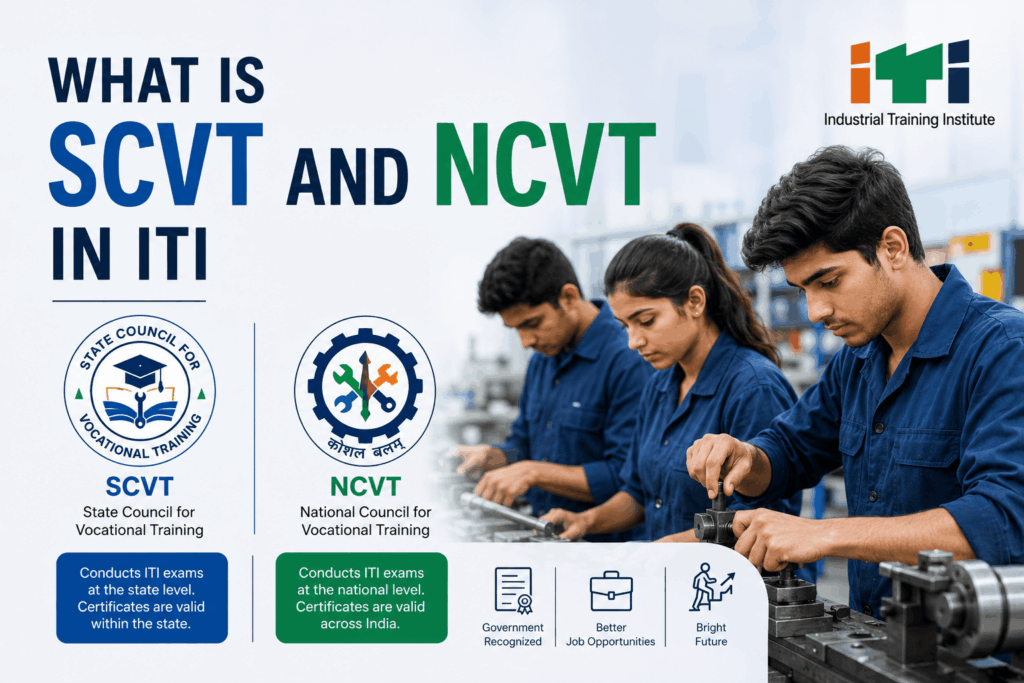
When students enrol in an ITI, one of the most important — and most overlooked — decisions they make is whether their institution is NCVT or SCVT affiliated. This choice directly affects which government jobs you can apply for, whether your certificate is recognised nationally or only in one state, and what your higher education options look like. This guide explains exactly what NCVT and SCVT are, how they differ, and which one you should choose.
What Are NCVT and SCVT?
Both NCVT and SCVT are certification bodies for ITI trades in India. Every ITI in the country — government or private — must be affiliated with one of these two bodies. The affiliation determines the syllabus followed, the exams conducted, and the certificate awarded.
NCVT
National body
National Council for Vocational Training. Set up by the Government of India under the Ministry of Skill Development and Entrepreneurship. NCVT sets national standards for ITI trades, conducts All India Trade Tests (AITT), and awards the National Trade Certificate (NTC) — a nationally and internationally recognised qualification.
SCVT
State body
State Council for Vocational Training. A state-level body set up by each individual state government. SCVT regulates ITI trades within its own state, conducts state-level trade tests, and awards the State Trade Certificate (STC) — recognised within that state and for select state-level government posts.
💡 Simple way to remember
Think of NCVT as the national passport — valid everywhere. Think of SCVT as a state driving licence — valid within its jurisdiction but not always accepted elsewhere. Both certify the same skills, but their reach and recognition differ significantly.
NCVT — National Council for Vocational Training
NCVT was established in 1956 under the Apprentices Act and is India’s apex body for setting quality standards in vocational training. It operates under the Directorate General of Training (DGT), which falls under the Ministry of Skill Development and Entrepreneurship.
Governing body
Ministry of Skill Development and Entrepreneurship, Government of India. Operates through the Directorate General of Training (DGT).
Certificate awarded
National Trade Certificate (NTC) — upon passing the All India Trade Test (AITT). Valid nationally and accepted for international employment through NSDC.
Exam conducting body
All India Trade Test (AITT) conducted twice a year — January and July sessions. Results published on the NCVT-MIS portal (ncvtmis.gov.in).
Syllabus
Nationally standardised syllabus set by DGT. Same curriculum followed across all NCVT-affiliated ITIs in every state of India.
Job eligibility
Required for almost all central government posts — Indian Railways, DRDO, HAL, OFB, SSC, and most PSU recruitments. Mandatory for central apprenticeship registration.
Higher education
NCVT NTC is accepted for Polytechnic lateral entry in all states. Also accepted for overseas employment through NSDC and government-to-government skill programmes.
SCVT — State Council for Vocational Training
SCVT is the state-level equivalent of NCVT. Each state government maintains its own SCVT body to regulate ITI training within its boundaries. The syllabus, exam pattern, and certificate format vary from state to state, though most states align their curriculum closely with the NCVT framework.
Governing body
Respective State Government — through the State Directorate of Vocational Education and Training (DVET) or equivalent authority. Each state has its own SCVT board.
Certificate awarded
State Trade Certificate (STC) — recognised within the issuing state and for some state government posts. Recognition outside the state is limited and varies.
Exam conducting body
State-level trade tests conducted by the respective state DVET or examination board. Exam schedule and frequency vary by state.
Syllabus
State-specific syllabus — often similar to NCVT but not identical. Some states follow the NCVT curriculum closely; others have significant variations.
Job eligibility
Accepted for state government posts, state PSU recruitment, and state-level apprenticeship programmes. Generally not accepted for central government or PSU vacancies.
Higher education
Polytechnic lateral entry acceptance varies by state — some states accept SCVT for their own polytechnics, others require NCVT. Always check your state’s specific rules.
NCVT vs SCVT — Side-by-Side Comparison
A detailed head-to-head breakdown across every parameter that matters to a student:
Government Job Eligibility: The Critical Difference
This is where the NCVT vs SCVT decision has the most impact. Here is how it plays out in real recruitment scenarios:
| Recruitment | NCVT Accepted? | SCVT Accepted? |
|---|---|---|
| RRB ALP & Technician (Indian Railways) | Yes | No |
| DRDO CEPTAM (Technician-A) | Yes | No |
| HAL Trade Apprentice / Technician | Yes | No |
| Ordnance Factory Board (OFB) | Yes | No |
| SSC Technical Posts | Yes | Generally No |
| BHEL / NTPC / ONGC Apprentice | Yes | No (NAPS registration) |
| State PWD / Electricity Board | Yes | Yes (in issuing state) |
| State Transport Corporation (SRTC) | Yes | Yes (in issuing state) |
| Army / Navy Civilian Technical | Yes | No |
⚠ Critical warning
Students who complete ITI from an SCVT-only affiliated institution are ineligible for the majority of central government jobs — including all Railways, defence PSU, and central government technical posts. This is a permanent limitation on your certificate. Always verify NCVT affiliation before enrolling.
How to Check if an ITI is NCVT or SCVT Affiliated
Before enrolling in any ITI — government or private — always verify its affiliation status. Here is how:
NCVT-MIS Portal
Visit ncvtmis.gov.in → Go to “ITI” section → Search by state, district, or ITI name. The portal lists all NCVT-affiliated ITIs and the specific trades that are NCVT-certified. Note: not all trades in an ITI may be NCVT-affiliated.
Ask the ITI directly
Ask the admission office specifically: “Is this trade NCVT affiliated or SCVT?” Ask for the affiliation number and cross-verify on the NCVT-MIS portal. Do not accept verbal assurances alone.
Check the admission form
NCVT-affiliated ITIs typically mention their affiliation number on admission forms, brochures, and institution letterheads. The certificate you receive at the end will clearly state NCVT or SCVT.
State DVET portal
For SCVT-affiliated institutions, check your state’s DVET portal. This lists all state-affiliated ITIs and their approved trade lists. Your state’s DVET website is the authoritative source for SCVT information.
💡 Important nuance
An ITI can have both NCVT and SCVT affiliated trades. For example, the Electrician and Fitter trades may be NCVT-affiliated in an institution while some other trades are only SCVT-affiliated. Always check the affiliation for the specific trade you want to join — not just the institution’s general affiliation status.
Can SCVT be Converted to NCVT?
This is one of the most commonly asked questions by students who realise after completing their ITI that they hold an SCVT certificate. The honest answer is nuanced:
Appear for AITT directly
Possible in some states
Some states allow SCVT certificate holders to appear for the NCVT All India Trade Test (AITT) as private candidates. If you pass, you receive the NTC. Check with your state DVET and the NCVT-MIS portal for current eligibility rules.
Re-enrol in an NCVT ITI
Always available
You can re-enrol in the same trade at an NCVT-affiliated ITI and complete the course again. Most institutions allow credit transfer or exemption for prior training, reducing the time needed to just sit for the AITT exam.
No automatic upgrade
Important to know
There is no government-sanctioned automatic conversion scheme that upgrades SCVT to NCVT. Simply holding an SCVT certificate and requesting an upgrade does not work. You must appear for and pass the AITT to receive an NTC.
Which Should You Choose: NCVT or SCVT?
Choose NCVT if you…
• Plan to apply for central govt jobs (Railways, DRDO, HAL, OFB)
• Want to work across different states in India
• Are interested in overseas employment through NSDC
• Plan to do a Polytechnic lateral entry (all states)
• Want to register for NAPS central apprenticeship
• Value nationally recognised credentials
SCVT may be acceptable if…
• You are targeting only state government posts in your home state
• You want to start self-employment locally after ITI
• The specific trade is not NCVT-affiliated at any nearby ITI
• You plan to convert to NCVT later by appearing for AITT
• Admission to an NCVT ITI was not possible due to competition
⭐ Bottom line recommendation
If there is any possibility of joining a government sector job, working in another state, or going abroad — always choose NCVT. The slight additional competition for NCVT government ITI seats is entirely worth it. SCVT should only be a fallback when NCVT is genuinely not available for your preferred trade in your area.
Common Myths — Cleared
Myth: All ITIs are NCVT affiliated
False
Many private ITIs and even some government ITIs are SCVT-only for certain trades. Never assume — always verify on ncvtmis.gov.in before enrolling.
Myth: SCVT and NCVT are equally valued
False
For central government jobs, PSU recruitment, and overseas employment, NCVT is explicitly required in almost every notification. SCVT is simply not accepted for these opportunities.
Myth: Private ITIs are always SCVT
Misleading
Many private ITIs are also NCVT-affiliated for specific trades. Private does not automatically mean SCVT. Always check the specific trade’s affiliation status on the NCVT-MIS portal.
Myth: SCVT can be easily upgraded later
False
There is no simple upgrade path. Converting requires either re-enrolment or appearing for AITT as a private candidate — both take significant time and effort. Prevention is better than cure.
Final Word
NCVT and SCVT are not just administrative labels — they determine the actual value and reach of your ITI certificate in the job market. NCVT is the gold standard: it opens central government jobs, enables cross-state mobility, supports overseas employment, and provides universally accepted credentials for higher education. SCVT has its place for state-level employment and self-employment — but its limitations are real and significant. Before enrolling in any ITI, spending five minutes verifying affiliation on ncvtmis.gov.in is the single most important step you can take to protect your career prospects.