
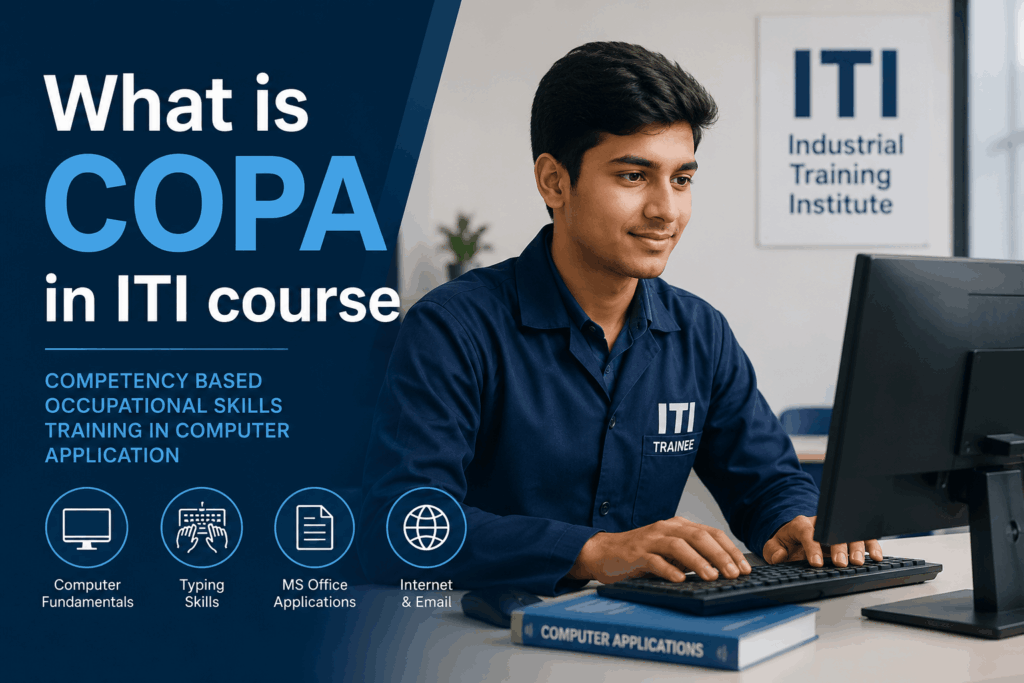
If you’re a 10th-pass student who enjoys working with computers and wants a short, job-focused course to get started quickly, COPA is one of the most popular ITI trades in the country. This guide walks you through exactly what COPA is, who can join, what you’ll learn, and where it can take your career.
What is COPA in ITI?
COPA stands for Computer Operator and Programming Assistant. It is a one-year Craftsman Training Scheme (CTS) trade recognised by the National Council for Vocational Training (NCVT) and delivered under the Directorate General of Training (DGT), Ministry of Skill Development and Entrepreneurship. It is one of the few “non-engineering” trades offered at ITIs — meaning it doesn’t require a Science or Maths background, making it accessible to students from any stream.
The course is designed to build practical, job-ready computer skills: operating systems, office productivity software, internet and email usage, data entry, basic programming logic, and foundational cybersecurity awareness. It is aimed at producing entry-level computer operators, data entry professionals, and programming assistants who can step into office and IT-support roles almost immediately after graduating.
Full Trade Name
Computer Operator and Programming Assistant, commonly written as “COPA” in admission brochures and counselling forms.
Duration
1 year, divided into 2 semesters of 6 months each — one of the shortest trades offered at ITIs.
Certifying Body
NCVT / NCVET, under DGT. Successful candidates receive the National Trade Certificate (NTC), recognised across India.
NSQF Level
The revised (2022 onward) COPA curriculum is aligned to NSQF Level 3, focused on job-ready, entry-level computer skills.
💡 In simple terms
Think of COPA as a practical, one-year bridge between “I know how to use a computer casually” and “I can confidently operate one in a professional office or IT environment” — covering everything from typing and MS Office to basic programming logic.
Eligibility Criteria for Admission
COPA has one of the most open eligibility criteria among ITI trades, which is part of why it attracts such a wide range of students.
Educational Qualification
Pass in Class 10 (Secondary/Matriculation) from a recognised board. No Science or Maths stream is required — students from any stream can apply.
Minimum Marks
Most institutes require around 33–35% marks in Class 10, with relaxations for reserved categories as per state norms.
Age Limit
Generally 14 years and above at the time of admission, with no strict upper age limit in most states.
Admission Route
Merit-based admission through the centralised state ITI counselling process, using Class 10 marks. Persons with Disabilities (PwD) are also eligible for this trade.
Course Duration & Structure
COPA is structured into a Domain area (trade theory and hands-on practical work) and a Core area (employability and life skills), spread across two semesters.
| Course Element | What It Covers |
|---|---|
| Trade Practical | Hands-on lab work — computer operation, typing, software use, data entry, basic programming exercises |
| Trade Theory | Concepts behind computer hardware, operating systems, networks, databases and programming logic |
| Employability Skills | Communication, workplace etiquette, basic English, digital literacy and career readiness |
Assessment combines practical tests (such as typing speed and software tasks), written theory exams, and project work, before the National Trade Certificate is awarded.
Syllabus – What You Will Study
The syllabus starts with computer fundamentals in the first semester and moves toward applied office, internet and programming skills in the second.
Computer Fundamentals
Evolution of computers, hardware components, number systems, and the role of computers in daily life and industry.
Operating Systems
Working with Windows and Linux, the booting process, DOS command-line basics, and file/folder management.
Office Applications
MS Word, Excel and PowerPoint (or equivalent), used for document creation, spreadsheets, presentations and basic accounting tools like Tally.
Internet & Digital Skills
Web browsing, email, online research, e-governance services, and an introduction to cybersecurity and safe internet practices.
Data Entry & Typing
Touch-typing practice, speed and accuracy building, and structured data entry into spreadsheets and forms.
Programming Basics
Introduction to programming logic and a beginner-level language, along with basic concepts of databases.
💡 Core skills you build
Fast, accurate typing · confident use of Windows/Linux · MS Office proficiency · internet research and email etiquette · structured data entry · basic programming logic · awareness of cybersecurity and safe computing.
Career Scope & Job Roles
Because computer skills are needed in almost every office, COPA graduates find opportunities across a wide range of sectors.
| Sector | Typical Job Roles |
|---|---|
| Private Offices & BPOs | Computer Operator, Data Entry Operator, Office Assistant |
| Government Offices | Data Entry Operator, Computer Operator-cum-Clerk |
| Public Sector Undertakings | Technician (Computer), Trade Apprentice — Railways, BHEL, HAL |
| IT-Enabled Services | Programming Assistant, Junior Software Support, Tally Operator |
| Banking & Retail | Data Entry & billing roles, back-office support |
| Self-Employment | Cyber cafe, DTP/data entry service, freelance office support |
Government Sector
Steady Demand
Government offices, PSUs and departments regularly need Data Entry Operators and Computer Operators — roles well suited to COPA-trained candidates.
Private Sector
Widely Available
Almost every private business — from small offices to large BPOs — needs staff comfortable with computers, office software and data entry.
Apprenticeship (NAPS/NAC)
Recommended First Step
Many students join a one-year apprenticeship with organisations such as Railways, BHEL or HAL after ITI, gaining practical exposure and a National Apprenticeship Certificate.
Salary Expectations
As a short, entry-level trade, COPA salaries tend to be modest at the very start but grow with experience, typing speed, software proficiency and sector.
Government / PSU Roles
• Data Entry Operator posts generally offer stable pay scales with allowances
• Apprenticeship stipends typically range from about ₹7,000–₹10,000 per month
• Job security and defined increments over time
Private Sector Roles
• Fresher salaries typically fall around ₹1–₹2.5 lakh per annum
• Pay improves with speed, accuracy and software/Tally skills
• Additional certifications in advanced Excel or Tally can boost offers
⚠ Note
Salary figures vary widely by employer, city and the candidate’s typing speed and software skills. Treat these as indicative ranges, not guarantees, and always verify current openings and pay scales on official recruitment notifications.
Higher Education & Career Growth
COPA is often the starting point rather than the finish line — many students use it to build a foundation before specialising further.
Diploma in Computer Applications
A natural next step for COPA graduates who want deeper software and IT knowledge in a structured diploma format.
Tally & Accounting Certifications
Short certification courses in Tally, GST and basic accounting open doors into office administration and finance-support roles.
Advanced IT/Software Courses
Motivated students often go on to learn web development, graphic design, or programming languages to move into higher-paying IT roles.
Crafts Instructor Training (CITS)
Experienced COPA-trained professionals can pursue CITS to become trade instructors within the ITI system itself.
COPA vs Other Popular ITI Trades
Students often compare COPA with engineering trades like Electrician or Fitter. Here’s a quick way to think about the difference:
COPA
• 1-year, non-engineering, open to any stream
• Desk-based, computer and office-skills focused
• Faster entry into the job market
• Best suited to office, data and IT-support roles
Engineering Trades (e.g. Electrician, Fitter)
• 2-year, technical/engineering trades
• Hands-on workshop and equipment-based training
• Stronger fit for core manufacturing/PSU technical roles
• Generally higher entry-level government pay scales
💡 Which one should you choose?
If you enjoy working at a desk, want a faster route to a job, and are comfortable with computers, COPA is an excellent choice. If you’re drawn to hands-on technical work with machines, tools and equipment, a two-year engineering trade may suit you better. Both are valid, NCVT-recognised paths.
Frequently Asked Questions
Is COPA a good trade for students without a Science background?
Yes. COPA is a non-engineering trade with no Maths or Science prerequisite, which makes it one of the most accessible ITI courses for students from any academic stream.
Do I need prior computer knowledge before joining COPA?
No. The course starts from computer fundamentals and builds up progressively, so students with little or no prior computer exposure can join and learn comfortably.
Can I get a government job directly after completing COPA?
Many students first complete a one-year apprenticeship to gain practical exposure, then apply for Data Entry Operator or Computer Operator posts in government offices and PSUs through official recruitment notifications.
What is the difference between COPA and a regular computer course outside ITI?
COPA is a government-recognised, NCVT-certified trade with a standardised syllabus, structured practical training and a National Trade Certificate on completion — giving it wider recognition for government and PSU recruitment compared to most private, unregulated computer courses.
Can I pursue further studies after completing COPA?
Yes. Many students go on to pursue a Diploma in Computer Applications, Tally and accounting certifications, or advanced IT/programming courses to strengthen their career prospects further.
Final Word
COPA is one of the most practical and accessible ITI trades available today — a one-year course that equips students with real, job-ready computer skills without requiring a technical academic background. It suits students who want a quick, focused path into office, data-entry and IT-support roles, with clear options to specialise further through diplomas or certifications later on. At Narayana ITI, the COPA programme is delivered with hands-on lab time, current software tools, and a strong focus on employability skills, so students are genuinely workplace-ready by the time they graduate.