
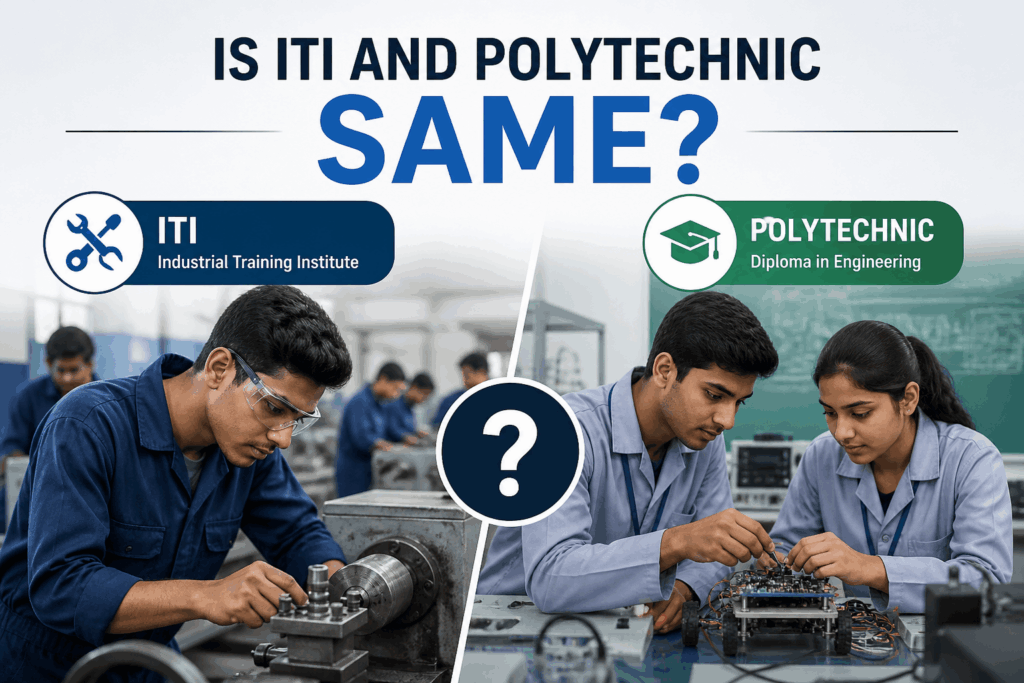
Two of the most popular career paths after Class 10 in India — yet many students and parents confuse them, or assume they’re interchangeable. ITI and Polytechnic are fundamentally different in their structure, purpose, qualification level, and career outcomes. This guide breaks down every difference so you can make an informed choice.
The Direct Answer
No — ITI and Polytechnic are not the same. While both are vocational/technical education options available after Class 10, they differ significantly in qualification level, course duration, academic depth, career scope, and the kind of jobs they prepare you for. Knowing the difference is essential before you apply.
Think of it this way: ITI prepares you to do a trade with your hands and tools — you become a certified tradesperson. Polytechnic prepares you to understand and apply engineering principles — you become a diploma-level technician or junior engineer. Both are valuable, but they lead to very different careers.
What is ITI?
An Industrial Training Institute (ITI) is a government-established institution that provides trade-specific vocational training. ITIs are governed by the Directorate General of Training (DGT) under the Ministry of Skill Development, and certifications are awarded by the National Council for Vocational Training (NCVT) or State Council for Vocational Training (SCVT).
Focus
Hands-on skill training in a specific trade — welding, electrical work, fitting, plumbing, COPA, etc. Practical, tool-based learning with minimal theory.
Duration
6 months to 2 years depending on the trade. Most engineering trades take 2 years; many non-engineering trades take 1 year.
Qualification
National Trade Certificate (NTC) or National Apprenticeship Certificate (NAC). Not equivalent to a Diploma or degree.
Entry requirement
Class 8 or Class 10 pass depending on the trade. No entrance exam — merit-based admission on Class 10 marks.
What is Polytechnic?
A Polytechnic (also called a Government Polytechnic or Polytechnic College) is an institution offering Diploma in Engineering or Technology programmes. These are regulated by the All India Council for Technical Education (AICTE) and affiliated to State Technical Education Boards. The Diploma awarded is equivalent to the first year of a B.Tech/B.E. degree for lateral entry purposes.
Focus
Theory and applied engineering across a branch — Civil, Mechanical, Electrical, Electronics, Computer Science, and more.
Duration
3 years (6 semesters). Fixed duration across all diploma programmes regardless of branch chosen.
Qualification
Diploma in Engineering / Technology. Recognised for government engineering posts and lateral entry into B.Tech (2nd year).
Entry requirement
Class 10 pass with Maths and Science. Most states hold an entrance exam (e.g. JEECUP in UP, DET in Karnataka).
Head-to-Head Comparison
A detailed side-by-side breakdown across every major parameter:
What ITI and Polytechnic Have in Common
Despite their differences, the two paths share a number of important features:
Entry after Class 10
Both are accessible to students who have passed Class 10 — the two primary technical career routes at this stage of education.
Government institutions
Both have strong government-run counterparts that charge lower fees and carry higher credibility with employers and PSU recruiters.
No Class 12 needed
Neither requires Class 12 board exams — both allow students to exit the traditional academic track early and enter technical training.
Lateral higher education
ITI holders can enter Polytechnic 2nd year; Polytechnic holders can enter B.Tech 2nd year — both paths lead upward.
Industry-oriented
Both are designed with industry needs in mind — not purely academic curricula. Both include practical labs and workshops.
Job-ready outcomes
Both produce employment-ready graduates unlike academic streams that often require further study before workforce entry.
Career Paths: How They Differ
The clearest way to understand the difference is to look at the actual jobs each qualification leads to:
| Job Role | ITI Eligible | Polytechnic Eligible | Typical Salary |
|---|---|---|---|
| Electrician / Wireman | Yes | Overqualified | ₹15,000–30,000/mo |
| Junior Engineer (SSC JE) | No | Yes | ₹35,000–55,000/mo |
| Railway Technician (NTPC) | Yes | Yes | ₹25,000–40,000/mo |
| Draughtsman / CAD Operator | Yes | Yes | ₹18,000–40,000/mo |
| Diploma Engineer (PSU) | No | Yes | ₹30,000–55,000/mo |
| Fitter / Machinist | Yes | Overqualified | ₹15,000–35,000/mo |
| Overseas Skilled Worker | Yes | Yes | ₹50,000–1,20,000/mo |
| Production Supervisor | Limited | Yes (with experience) | ₹30,000–60,000/mo |
💡 Note on salary
Polytechnic Diploma holders generally start at higher salaries — but experienced ITI tradespeople (especially in specialised trades or overseas placements) can outperform many Diploma engineers within 5–7 years of working.
The Upgrade Path: How They Connect
Both qualifications are stepping stones — not dead ends. Here is the full progression ladder for each:
▶ ITI pathway
▶ Polytechnic pathway
⭐ Key insight
ITI holders can directly enter the second year of a Polytechnic Diploma through lateral entry — effectively completing the full Diploma in just one additional year. This makes ITI a natural bridge, not a dead end.
Which One Should You Choose?
The right choice depends entirely on your goals, financial situation, and timeline. Here is a structured breakdown:
Choose ITI if you…
• Want to start earning within 1–2 years
• Prefer hands-on, practical work over theory
• Have budget constraints (fees are very low)
• Are targeting trade-based govt jobs (Railways, SSC)
• Want to work overseas as a skilled tradesperson
• Plan to start your own workshop or business
• Scored below 60% in Class 10 Maths & Science
Choose Polytechnic if you…
• Aim for Junior Engineer or supervisory roles
• Plan to pursue B.Tech via lateral entry
• Are interested in engineering theory and design
• Want to work in core engineering companies
• Are targeting SSC JE, DRDO, or PSU diploma posts
• Have a stronger Maths and Science background
• Can invest 3 years before entering the workforce
⚠ Common misconception
Many students assume Polytechnic is always “better” than ITI because it takes longer and costs more. This is not true. A skilled electrician or welder with 5 years of experience can earn significantly more than many diploma engineers in entry-level roles. The best path is the one aligned with your strengths and goals.
Common Myths — Busted
Myth: ITI is only for those who failed
False
ITI is a deliberate career choice. Thousands of students with strong marks choose ITI specifically for its fast employment track and overseas opportunities.
Myth: Polytechnic guarantees better jobs
Misleading
Job outcomes depend on sector, specialisation, and experience — not just qualification level. Specialised ITI trades can pay more than many diploma-level positions.
Myth: You can’t study further after ITI
False
ITI holders can enter Polytechnic 2nd year, then B.Tech 2nd year — achieving a full engineering degree through a structured, affordable path.
Myth: They teach the same things
False
ITI teaches trade-specific skills (how to wire a panel, weld a joint). Polytechnic teaches engineering principles (circuit theory, thermodynamics, materials science).
Final Verdict
ITI and Polytechnic are not the same — they are two distinct qualifications designed for different types of learners and career goals. ITI is faster, cheaper, and intensely practical — ideal for students who want to enter the workforce quickly or work overseas. Polytechnic takes longer and goes deeper into engineering theory — ideal for those who want supervisory, design, or further academic roles. Neither is superior in absolute terms. The right choice is the one that fits your goals, timeline, and working style. And remember: the two paths are not mutually exclusive — an ITI graduate can always move into Polytechnic, and onward to a full engineering degree.