
🔧 Trade Guide · Engineering Trades
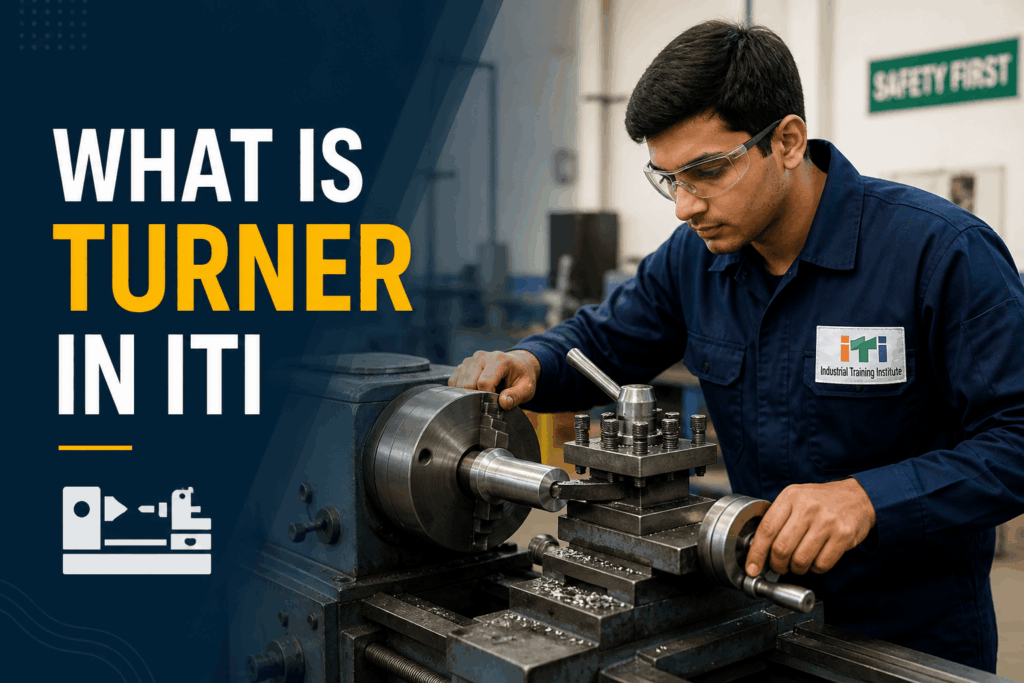
What is Turner in ITI?
A Complete Trade Guide
If you enjoy working with your hands, like the idea of shaping raw metal into precise machine parts, and want a trade with steady demand in factories, railways and defence establishments, Turner is one of the most established trades offered at ITIs across India. This guide covers everything a student or parent needs to know — what the trade is, who can join, what you’ll study, the machines you’ll master, and the career paths that open up after you complete it.
What is Turner ITI?
Turner is a two-year Craftsman Training Scheme (CTS) trade recognised by the National Council for Vocational Training (NCVT) and regulated by the Directorate General of Training (DGT) under the Ministry of Skill Development and Entrepreneurship. The trade trains students to operate lathe machines and related machine tools to shape metal (and occasionally other materials) into components with exact dimensions, shapes and finishes.
A Turner works at the heart of the manufacturing process. You learn to mount a workpiece on a lathe and rotate it against a cutting tool to perform operations such as facing, turning, taper turning, threading, knurling and boring — converting a rough metal blank into a finished, dimensionally accurate part, guided by engineering drawings and precision measuring instruments.
Full Trade Name
Turner — a core Craftsman Training Scheme (CTS) trade offered under the Engineering trades group at NCVT/SCVT-affiliated ITIs.
Duration
2 years, divided into 4 semesters of 6 months each, under the semester pattern followed by most NCVT-affiliated ITIs.
Certifying Body
NCVT / DGT. Successful candidates receive the National Trade Certificate (NTC), recognised across India and abroad.
NSQF Level
The trade is aligned to NSQF Level 4 under the current CTS 2.0 curriculum, making it eligible for credit transfer into diploma programmes.
💡 In simple terms
Think of a Turner as a precision metal shaper. Almost every machine part — bolts, shafts, bushings, pins, gears — starts life as a rough metal blank. The Turner’s job is to mount that blank on a lathe and cut it down, layer by layer, until it matches the exact size and shape shown on the engineering drawing.
Eligibility Criteria for Admission
Admission requirements are broadly similar across NCVT-affiliated ITIs, though exact percentage cut-offs can vary slightly by state and institute.
Educational Qualification
Pass in Class 10 (Secondary/Matriculation) from a recognised board, with Science and Mathematics. Students with a Maths and Science background generally find the calculation and drawing components easier.
Minimum Marks
Most institutes require around 35–50% marks in Class 10, though this varies by state and category (relaxation applicable for reserved categories).
Age Limit
Typically 14–40 years at the time of admission, as per DGT norms, though many states set a minimum of 14 or 15 years.
Admission Route
Selection is usually merit-based, using Class 10 marks, through the centralised state ITI admission counselling process. Some private institutes also offer direct admission.
Course Duration & Structure
The trade runs for two years and is organised into a Domain area (trade theory and practical shop-floor work) and a Core area (employability and life skills), as per the DGT’s CTS 2.0 framework.
| Course Element | 1st Year (Hours) | 2nd Year (Hours) |
|---|---|---|
| Professional Skill (Trade Practical) | 840 | 840 |
| Professional Knowledge (Trade Theory) | 240 | 300 |
| Employability Skills | 120 | 60 |
| Total (approx.) | 1200 | 1200 |
In addition, every year includes a mandatory component of On-the-Job Training (OJT) with industry partners; where industry placement is not available, students complete a supervised group project instead.
Syllabus – What You Will Study
The syllabus builds progressively from basic workshop practice and lathe fundamentals in the first semester, to advanced turning operations and precision job work by the fourth semester.
Semester 1
Workshop safety and 5S practices, hand tools, marking and filing, introduction to the lathe machine, basic facing and plain turning.
Semester 2
Step turning, taper turning, drilling and boring on the lathe, use of vernier calipers and micrometers, reading engineering drawings.
Semester 3
Thread cutting (external and internal), knurling, eccentric turning, use of chucks and fixtures, limits, fits and tolerances.
Semester 4
Complex job production, taper and thread combinations, introduction to CNC lathe concepts, quality checking and project work.
💡 Core skills you build
Operating centre lathes safely · facing, turning, taper turning and thread cutting · reading and interpreting engineering drawings · using precision measuring instruments (vernier caliper, micrometer, dial gauge) · workshop calculation and applied science · understanding of materials and machinability · routine maintenance of lathe machines.
Career Scope & Job Roles
Turner is one of the most consistently in-demand ITI trades because precision machining skills are needed across nearly every manufacturing and engineering sector.
| Sector | Typical Job Roles |
|---|---|
| Manufacturing & Engineering | Lathe Operator, Machine Operator, Production Technician |
| Automobile Industry | Machining Assistant, Component Turner, Quality Checker |
| Public Sector Undertakings | Technician (Turner), Trade Apprentice — BHEL, SAIL, Railways |
| Defence & Aerospace | Turner, Machinist Support — DRDO, HAL, Ordnance Factories |
| Railways | Turner in loco/wagon workshops, RRB technical recruitment roles |
| Self-Employment | Own machine/job-work shop, small precision fabrication unit |
Government Sector
High Demand
PSUs and departments such as Railways, Defence Ordnance Factories, BHEL and SAIL regularly recruit ITI Turner holders as Technicians and Trade Apprentices, especially those with an NCVT certificate.
Private Sector
Wide Availability
Manufacturing units, automobile companies, machine tool workshops and precision engineering firms regularly hire skilled Turners and lathe operators.
Apprenticeship (NAPS/NAC)
Recommended First Step
Most freshers join a one-year apprenticeship after ITI to gain hands-on industry exposure and earn a National Apprenticeship Certificate before applying for permanent roles.
Salary Expectations
Starting pay for a fresher varies with sector, location and whether the role is government or private. As a general guide:
Government / PSU Roles
• Entry-level Technician pay scales typically start higher than private-sector openings
• Regular increments, allowances and job security
• Apprenticeship stipends usually range from about ₹9,000–₹12,000 per month
Private Sector Roles
• Fresher salaries typically fall around ₹1.2–₹3.3 lakh per annum
• Salaries rise noticeably with CNC lathe experience
• Metro-city and industrial-hub manufacturing units generally pay more than smaller towns
⚠ Note
Salary figures vary widely by employer, city, and the candidate’s additional CNC machining skills. Treat these as indicative ranges, not guarantees, and always verify current openings and pay scales on official recruitment notifications.
Higher Education & Career Growth
Turner is not a career dead-end — it is a strong launchpad for further technical education and advanced machining careers.
Diploma (Lateral Entry)
Many state polytechnics accept ITI Turner certificate holders for lateral entry into the 2nd year of a Diploma in Mechanical Engineering.
CNC Machining Courses
Short-term certifications in CNC turning, CNC programming and VMC/CNC operation significantly widen job opportunities and pay scale.
Crafts Instructor Training (CITS)
Experienced Turners can pursue CITS to become trade instructors within the ITI system itself.
B.Tech via Lateral Entry
After a diploma, students can pursue B.Tech in Mechanical Engineering through state-level lateral entry schemes.
Turner vs Fitter
These two engineering trades are often confused by new students. Here is how they differ:
Turner
• Focuses on machining components on a lathe
• Work is machine-based: turning, facing, threading, boring
• Career path toward machine shops, CNC operation, production units
• Key equipment: centre lathe, CNC lathe, precision measuring tools
Fitter
• Focuses on assembling, fitting and maintaining machine parts
• Work is largely manual: filing, fitting, assembly, maintenance
• Career path toward maintenance, assembly lines, mechanical fitting roles
• Key equipment: hand tools, measuring gauges, assembly fixtures
💡 Which one should you choose?
If you’re drawn to operating machines and shaping metal with precision, choose Turner. If you’re more interested in assembling, fitting and maintaining machinery, Fitter is the better fit. Both are NCVT-recognised, two-year trades with strong industry demand.
Frequently Asked Questions
Is Turner a good trade for beginners with no workshop experience?
Yes. The course starts from basic workshop safety and hand tools before introducing the lathe machine, so no prior workshop experience is required at entry.
Do I need to be physically strong to become a Turner?
Reasonable physical fitness helps, since the work involves standing at a machine and handling metal workpieces, but it is more about precision, focus and steady hands than raw strength.
Can I get a government job directly after this ITI trade?
Most students first complete a one-year apprenticeship (NAPS/NAC) to gain practical exposure, then apply for Technician or Trade Apprentice posts in PSUs, Railways and Defence establishments through official recruitment notifications.
What is the difference between a manual lathe and a CNC lathe taught in this trade?
A manual (centre) lathe is operated directly by hand wheels and levers, and forms the foundation of the trade. A CNC lathe is computer-controlled and produces parts automatically from a programmed code — most ITIs introduce CNC concepts in the later semesters as an extension of manual lathe skills.
Can I pursue engineering after completing this ITI trade?
Yes. Many students use this trade as a stepping stone — first into a Diploma in Mechanical Engineering through lateral entry, and later into a B.Tech programme through state-level lateral entry schemes.
Final Word
Turner is a time-tested, hands-on ITI trade that sits at the core of India’s manufacturing and engineering ecosystem. It suits students who enjoy precision work, are comfortable around machines, and want a qualification that opens doors to both government technical roles and private-sector production careers — with a clear path to CNC machining, diploma and degree studies if you choose to continue. At Narayana ITI, the Turner programme is delivered with a strong focus on manual lathe fundamentals alongside modern machining awareness, so students leave workshop-ready and industry-ready.